
A single line in a patch notes post is enough to make thousands of players drop a champion overnight — and most of them never check whether the nerf actually mattered. Patch 26.15 hit  Naafiri Naafiri jungle ,
  Riven Riven top and Locke with real, numbered changes, and the community reaction to all three was the same: “she’s dead,” “unplayable now,” “don’t bother.” Two patches later, the win rate data on lolalytics and u.gg tells a different story for two of the three, and even the one genuine casualty recovered faster than the panic did. The gap between what a patch note says and what the resulting data shows is where most players make a bad decision that costs them nothing but comfort.
What Patch 26.15 Actually Changed

Patch 26.15 (released July 29, 2026, alongside the League Classic mode) targeted three very different champions with three very different nerfs, according to Riot’s official patch notes and the pre-patch balance coverage that followed it:
- Naafiri had her ultimate’s base damage on Hounds’ Pursuit reduced from 150/225/300 to 125/200/275 — a straight numeric cut that also indirectly weakened her jungle clear speed, since her packmates deal less damage on the same ability.
- Riven was nerfed after Gluttonous Greaves and the Endless Hunger rune change had quietly pushed her sustain and itemization past what Riot intended, making her the highest win-rate fighter in the game before the patch landed.
- Locke, the AP mid assassin who launched in patch 26.13, got broad numbers taken down across the board — Riot’s stated reasoning was that he punished mistakes early but didn’t fall off enough in the late game to balance that power.
Three champions, three nerfs, one shared outcome in the community: all three got labeled “unplayable” within days. Only one of them actually was — and only for a couple of weeks.
Naafiri: A Nuance Nerf Read as a Death Sentence
A 25-per-rank cut to one ability’s base damage is the kind of change that barely registers in a full patch note wall of text. It didn’t read that way to the playerbase. Coverage in the days after 26.15 framed Naafiri jungle as having dropped to the “lowest win rate” bracket in the game and suggested players move her to mid lane instead — the kind of headline that sticks even after the numbers move.
They did move. By patch 26.17, Naafiri jungle sits at a 49.7% win rate with a 3.9% pick rate and an A-tier rating on Mobalytics, and a 49.5% win rate with a 7.6% ban rate on Blitz.gg across more than 76,000 Emerald+ matches. That’s not a fringe pick propped up by a handful of one-trick outliers — that’s a role-relevant jungler performing within a point of dead-even, two patches after the nerf that supposedly ended her.
Naafiri Naafiri jungle is the cleanest example of a nuance nerf: real, documented, and small enough that it should have shifted her win rate by a fraction of a percent — which is exactly what happened. The perception shift was disproportionate to the actual power taken away. If you dropped her from your pool the week of the patch and never checked back, you gave up a champion that was fine the entire time. For more on how her kit earned the staying power to survive a nerf like this in the first place, the rework that made her stick is worth reading in full.
Riven: Nerfed at the Peak, Never Actually Fell
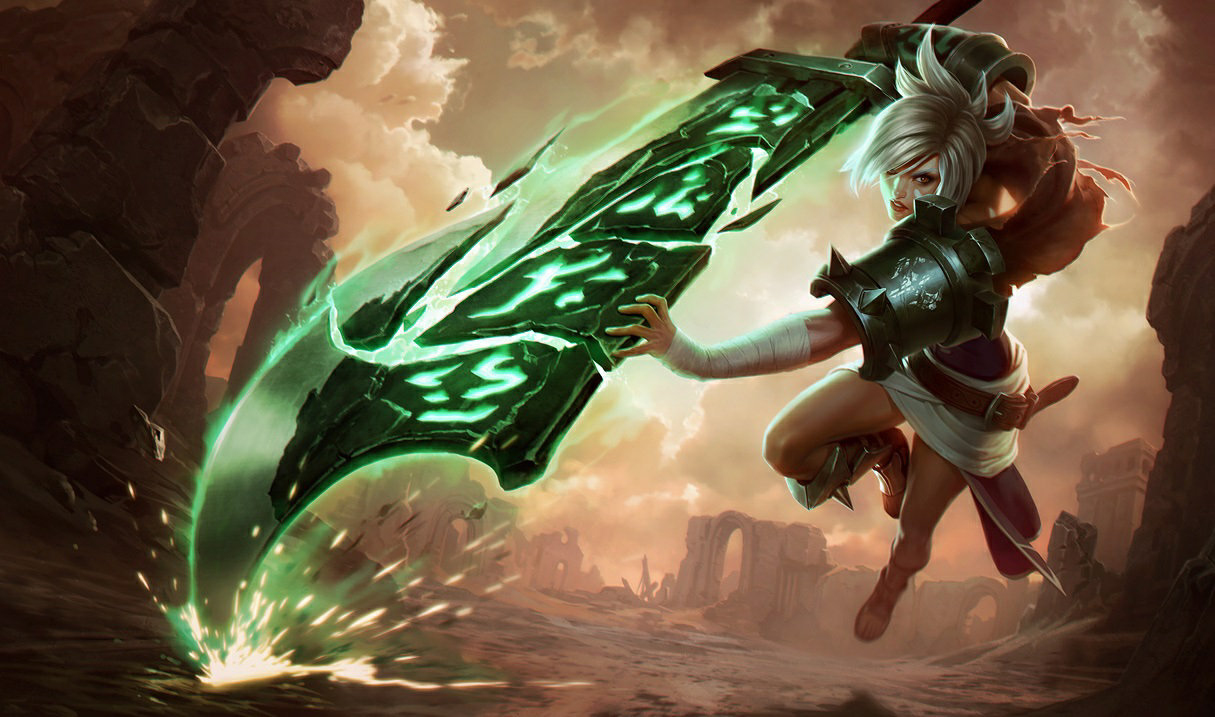
Riven Riven top is the opposite case: the nerf was a correction, not an overreaction, and the community treated it exactly like it should have — as an adjustment, not a verdict. Gluttonous Greaves and the Endless Hunger rune interaction had turned her into the highest-win-rate fighter in the game leading into the patch, and Riot pulled some of that sustain back out.
The result on patch 26.17: roughly a 49.5-49.7% win rate with a ~2.3% pick rate across both u.gg and op.gg. That’s a champion sitting almost exactly at 50%, which is what a well-targeted nerf is supposed to produce — not a crater, a correction. The players who kept picking her didn’t lose anything; the players who benched her the week of the patch skipped past a short adjustment period into a champion that landed right where Riot wanted her.
What makes Riven a useful contrast to Naafiri is that her execution ceiling is real: hundreds of hours of animation-cancel and combo-sequence practice still translate into results above her aggregate win rate for dedicated mains, as covered in our current top lane tier list. A nerf that lands a mechanically demanding champion at 49.5% doesn’t erase the skill expression that made her strong in the first place — it just removes the free sustain that had been propping up players who hadn’t earned it yet.
Locke: The One Real Dip — and How Fast It Recovered
Locke is the case that makes the pattern harder to dismiss, because the reaction to his nerf wasn’t disproportionate — right after patch 26.15 landed, his win rate genuinely dropped to roughly 45.3-46%, an F-tier result by any tier list’s standard. Riot had explicitly said they were trying to make him fall off harder into the late game, and for about two weeks, he did.
By patch 26.16 and into 26.17, Locke’s win rate climbed back to roughly 48.5-49.8%, and his pick rate settled at 5.5-6.4% — top-22% territory — while his ban rate held at 21.7%, still in the top 5% of the entire champion roster. The players and coaches who had figured out his post-nerf itemization and matchup priorities in the first two weeks recovered his power level faster than the general perception did. If you dropped him during the F-tier window and waited for public sentiment to catch up before picking him back up, you sat out several weeks of a champion that had already stabilized. If you want the full breakdown of his kit and current build path, the complete Locke guide covers it in depth.
This is the more honest version of the post-nerf panic: even when the initial reaction is correct, it tends to outlast the problem it was reacting to. A nerf that causes a real two-week dip doesn’t mean the champion stays weak for the rest of the patch cycle — it means the playerbase needs time to find the new optimal way to play around it.
Why Your Brain Treats a Patch Note Like a Verdict
None of this is about players being irrational for no reason — it’s a predictable pattern with a name. Patch notes read like a verdict because they’re framed as intent: Riot tells you what they were trying to do to a champion, in plain language, days before any real data exists to confirm whether it worked. A sentence like “her ultimate does less damage now” is processed the same way a loss is processed in general — as something to avoid immediately, not something to wait and measure.
That’s loss aversion doing the work: the fear of playing a weakened champion and losing games because of it outweighs the actual, usually small, amount of power that was removed. It’s compounded by an availability problem — the patch note headline is the thing you remember, while the follow-up win rate two patches later is buried in a stats site nobody revisits once they’ve already moved on. Naafiri’s “lowest win rate in the game” framing stuck around far longer than the data that eventually contradicted it, simply because the headline came first and the correction never got the same reach.
The irony is that the same instinct exists in reverse for buffs: a champion gets a small numbers-up patch note and immediately gets over-picked and over-banned for weeks, well past the point where the data shows the buff was minor. Patch notes describe a direction of change. They don’t describe the magnitude of the outcome — and treating the two as the same thing is what turns a footnote into a champion ban.
How to Actually Decide Whether to Drop a Champion
You don’t need to ignore patch notes — you need a process that stops you from reacting to them before the outcome exists. This is the same problem that aggregate win rate stats run into in the other direction: a single number without context can mislead just as easily as a patch note without data behind it yet.
Before you bench a nerfed champion
-
Read the actual number, not just the direction
A '-25 base damage' on one rank of an ultimate is a different event than a full ability rework or a cooldown increase across the kit. Direction (nerf/buff) tells you almost nothing about magnitude.
-
Wait for a real sample, not day-one anecdotes
Aggregators need real volume to stabilize — a handful of games right after a patch is noise, not signal. Give it at least a week of high-volume data before trusting a tier shift.
-
Check pick and ban rate, not just win rate
A champion with a falling win rate but a stable or rising ban rate (like Locke's 21.7%) is still respected by the people who play against them, which usually means the drop is temporary.
-
Separate 'my results got worse' from 'the champion got worse'
A build path or matchup approach that worked pre-nerf can be flat-out wrong post-nerf. Confirm your itemization and skill order actually adapted before blaming the champion.
-
Let live context override the headline mid-game
Tools like buildzcrank read your actual match state — gold lead, enemy build, game phase — instead of a patch note from two weeks ago, so a nerf that mattered in theory doesn't dictate a build choice that doesn't fit the game you're actually in.
FAQ
Is Naafiri still good after the patch 26.15 nerf?
Yes. On patch 26.17 she's sitting around a 49.5-49.7% win rate in the jungle with a healthy pick rate (Mobalytics, Blitz.gg), which is A/B-tier territory — the ultimate damage cut was real but small.
Was Riven's nerf in patch 26.15 justified?
Largely, yes. Gluttonous Greaves and an Endless Hunger interaction had pushed her sustain above intended levels; post-nerf she sits close to 49.5-49.7% win rate, which is where Riot wanted her.
How long did Locke stay weak after his patch 26.15 nerf?
About two patches. He dropped to roughly 45-46% win rate (F tier) immediately after 26.15, then recovered to 48.5-49.8% by patch 26.16-26.17 while keeping a top-5% ban rate throughout.
How do I know if a nerf actually hurt a champion or if it's just perception?
Wait for at least a week of post-patch data on an aggregator and compare pick/ban rate alongside win rate — a champion still being banned heavily despite a win rate dip is usually still respected by the playerbase, not actually weak.
Should I stop playing a champion the moment I see a nerf in patch notes?
No — check the size of the numeric change first. A small stat adjustment on one ability rarely moves win rate by more than a point or two, which is well within normal patch-to-patch variance.
Patch notes describe intent. Win rate data two patches later describes what actually happened — and the two aren’t the same thing nearly as often as the community’s day-one reaction implies. Naafiri and Riven never left balanced territory after their 26.15 nerfs; Locke had a genuine dip and still recovered inside two patches. None of that justifies benching a champion permanently off a single line of text. Before you drop your next nerfed pick, give the data the same two weeks it takes to actually exist — check the current tier list, read the patch notes for the exact numbers instead of the headline, and decide based on what happened, not what you were afraid would happen.