
How to Climb in League of Legends 2026 — Rank Up Guide
Struggling to climb in LoL 2026? Learn the proven strategies that move LP in Patch 26.9: champion pool, macro, wave management, and situational item decisions.
Buildzcrank Team Published Updated
Learning how to climb in League of Legends in 2026 is not about grinding 10 hours a day: it is about playing the right way. In Patch 26.9, WASD controls went live in ranked for the first time, the Pandemonium keystones (Deathfire Touch and Stormraider’s Surge) shifted the meta, and the gap between players who adapt and those who stagnate is wider than ever. Whether you are stuck in Iron or grinding to Master, the same core principles apply: discipline over volume, deliberate decisions over mechanical reflexes.
Why Most Players Plateau: And the Root Cause
Most players who are stuck in the same rank share one trait: they play a lot but learn very little. Volume without structure does not produce growth: it just reinforces bad habits.
The three most common causes of a rank plateau in 2026 are:
Plan to break your plateau
-
Shrink your pool
Pick 2-3 champions and play 30 games straight with them.
-
Review post-game
Spend 5 minutes after each ranked on one specific mistake.
-
Manage tilt
After 3 consecutive losses, take at least a 20-minute break.
1. Champion pool too wide. Playing 15 different champions means you never develop deep game knowledge on any of them. You are relearning matchups, power spikes, and win conditions every game instead of executing a known gameplan.
2. No post-game review habit. The average ranked game takes 30 minutes. Spending 5 minutes reviewing one critical mistake (a bad trade, a missed objective, a misread teamfight) is worth more than the next game you grind. Players who review even once per day improve measurably faster than those who do not.
3. Emotional cascades (tilt). A 2026 study by Amber.gg analyzing 500,000 ranked games found that players who went on a 3-game losing streak had a 67% chance of continuing to lose if they immediately queued again, compared to 41% if they took a break of at least 20 minutes. Tilt is not a mindset problem: it is a decision-making problem, and it compounds.
The fix is structural, not motivational. You do not need to “try harder.” You need to play fewer champions, review mistakes deliberately, and set hard limits on sessions when the games stop being productive. Every section of this guide follows that principle: less noise, more signal.
Build a Focused Champion Pool: 2-3 Champions Max
The single highest-leverage habit for climbing is narrowing your champion pool. The formula that works at every rank below Master is simple: one main, one backup, one flex.
- Main: The champion you know at 70+ mastery level. You understand every matchup, every power spike, every win condition.
- Backup: A champion for when your main is banned or countered, ideally in the same role and with a similar playstyle.
- Flex: A champion that fills a team need your first two cannot, usually a different role or a hard engage option.
Below Diamond, mastery beats meta consistently. A player on 300 games of Garen will outperform a player on 30 games of a theoretically stronger champion in 8 out of 10 cases. The meta knowledge ceiling for simple, dominant champions is also lower, which means you hit it faster.
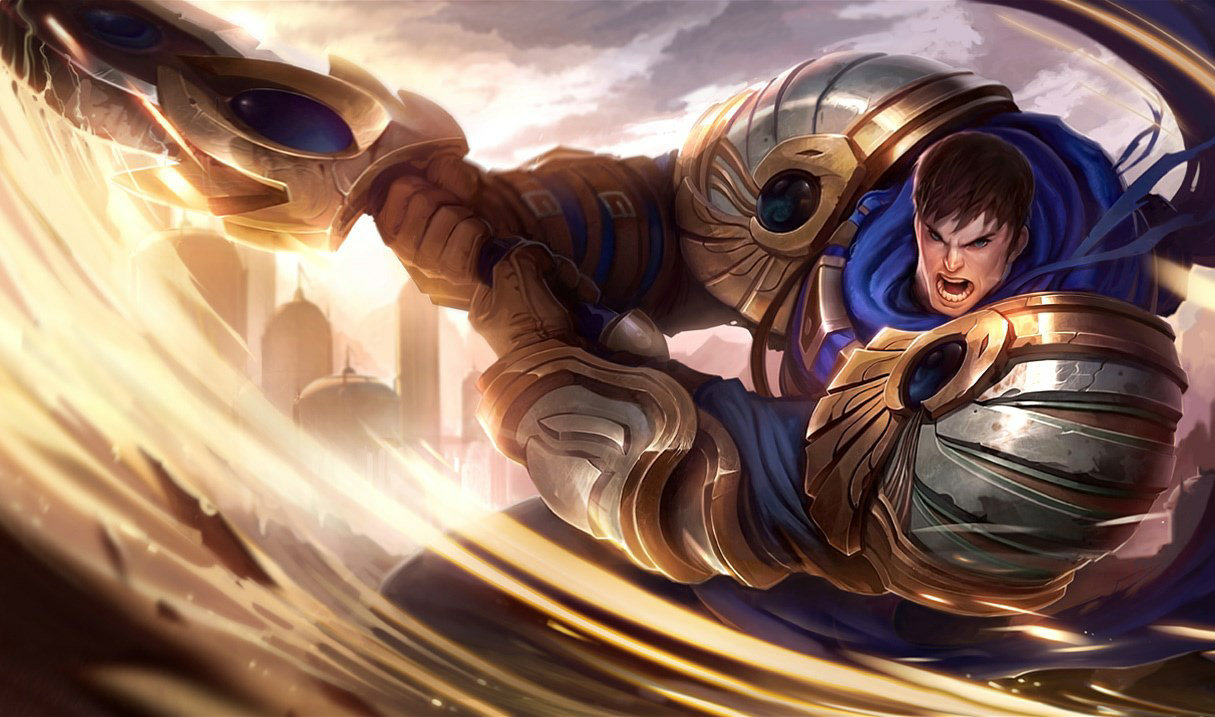
In Patch 26.9, Garen is the clearest example of a “low floor, high ceiling for LP gain” champion in top lane. He carries 13.3% pick rate and a 52% win rate across all elos: numbers that reflect how much easier it is to execute his kit than to play around his weaknesses. His passive sustain, his silence, and his ultimate that ignores MR make every game predictable in structure, even when the draft is not.
If you are deciding what to main, prioritise champions with consistent patterns over volatile ones. A champion that wins by doing the same thing every game is worth more LP than a champion with a high ceiling you rarely reach.

Macro Strategy: Win Before the Teamfights Start
Most players below Diamond lose games they “won” mechanically. The lead existed: they just had no idea how to convert it into a closed game. That is a macro problem, and macro is entirely learnable.
Vision control is the foundation. Wards do not just protect you; they enable objective fights. The pattern is always: ward the objective 90 seconds before spawn, clear enemy vision in the river corridor, force the fight with vision advantage rather than reacting blind.
Objective timing drives the game clock. In Patch 26.9, Baron spawns at 20 minutes. Every decision you make from minute 18 onward should be oriented around whether your team has the wave states and health to contest it. Dragon stacks compound: do not trade a Dragon for a single kill if you are already ahead in stacks.
Group vs split is a lead-size decision. If your team has 5k gold lead or more, grouping and forcing objectives is almost always correct: the enemy cannot match your team in a 5v5. If the lead is smaller, splitting pressure with a side laner who forces a response can create openings mid. The mistake most players make is splitting when the lead demands grouping, and grouping when the team needs space.
Converting leads means playing for spawns. After winning a teamfight, take the nearest turret, then reset to base. Do not over-chase kills across the map: a dead team respawns in 40-60 seconds in mid game, and that is enough time to lose everything you gained.
To know which champions win these macro patterns best in the current patch, check the LoL Tier List Patch 26.9 for the full breakdown of which picks are dominating objective play right now.
Wave Management: The Invisible LP Printer
If you are not thinking about wave state, you are leaving free LP on the table every single game. Wave management is one of the highest-skill-to-reward activities in LoL, and it costs nothing to learn the three core patterns.
Slow push (build a big wave): Last-hit efficiently while letting minions accumulate. Send a large wave crashing into the enemy tower: it either forces the enemy to defend, it destroys the tower if they do not, or it creates a Baron setup if your team moves together as the wave breaks.
Fast push (shove and leave): Kill the wave as fast as possible, then rotate to another lane or objective. The key insight: a shoved wave crashes and resets into a neutral state, denying your lane opponent the ability to freeze. Use this before roaming or before contesting Dragon.
Freeze (deny opponent CS): Keep the wave just inside your half of the lane, baiting your opponent to step up for CS while you trade damage. A correctly maintained freeze can deny an enemy laner 20-30 CS per 10 minutes: equivalent to 400-600 gold they never earn.
The connection most players miss is between wave state and buying windows. You should only base when your wave is crashing into the enemy tower or is naturally at a slow push peak. Basing with a frozen wave hands your opponent a free bounty of CS and resets the lane in their favor.
One CS every 10 seconds is roughly equal to one kill in gold value. Over a 30-minute game, the difference between 6 CS/min and 8 CS/min is approximately 1,200 gold: almost a full item component. Wave management is not a minor edge; it is the difference between one item and two.
Contextual Itemization: Adapt, Don’t Copy-Paste
Patch 26.9 introduced the Pandemonium keystones, Deathfire Touch and Stormraider’s Surge, and most players are still copy-pasting whichever u.gg lists first without understanding when each is correct.
Deathfire Touch applies a stacking burn on your target. It excels when you are fighting sustained skirmishes, when the enemy has healing that reduces burst value, and when you have multiple sources of damage-over-time in your kit. Mages with persistent damage patterns (Malzahar, Brand, Zyra) benefit enormously. Assassins who are already killing in one combo generally do not.
Stormraider’s Surge rewards burst damage with a movement speed boost, making it easier to chase down kills or escape after an all-in. Assassins and single-target burst mages (Syndra, Viktor, LeBlanc) scale better with Stormraider’s because the fight duration does not allow Deathfire’s burn to stack meaningfully.
Beyond keystones, the core principle is the same: itemize against what you are facing, not against the template. If their team has three tanks, build armor penetration. If they have three AP carries, build magic resistance on your front line and healing reduction on your assassins. A fixed item path is a ceiling: a responsive item path is how you climb.
Starting items are also shifting in 26.10. Doran’s Bow and Doran’s Helm are getting buffed, offering more sustain at the cost of later spike timing. If you play an ADC or a bruiser relying on early health sustain, the calculus on your opener is about to change.
For the full breakdown of the new items that are reshaping the 2026 meta, see the new items in LoL Patch 26.9 guide.
Mental Game: Consistency Over Streaks
Consistent LP gain is not about your best sessions: it is about eliminating your worst ones.
Set a hard stop at 3 losses in a row. This is not weakness; it is risk management. After three consecutive losses, the cognitive load and emotional state virtually guarantee the fourth game will be played at a lower level than your actual skill. Log off. The LP will be there tomorrow.
Review one game per day, not every game. Pick the game where you felt most confused or made the clearest mistake. Watch 5 minutes of your own gameplay and identify one repeatable decision you would change. One insight per day compounds over weeks: reviewing every game produces diminishing returns after the second watch.
Dodge bad drafts deliberately. If your team has no hard engage in a teamfight meta, or four AD carries against a Malphite and Galio, dodging loses you 3 LP and saves potentially 15-20 LP from a near-unwinnable game. The math favors the dodge far more often than players admit.
Play for impact, not KDA. A 2/5 game where you killed Baron and forced the enemy to respond is worth more than a 7/2 game where you farmed safely and achieved nothing. Ask “did I make the game harder for the enemy team?” after every match, not “was my KDA positive?”
Consistency compounds. Six reliable games in a row at 53% win rate generates more LP than alternating between 70% win rate peaks and 30% tilt spirals.
Best Roles and Champions to Climb in Patch 26.9
Patch 26.9 has clear LP-printing picks in every role. Here is where to focus if you are choosing a role to climb on.
Top Lane: Garen
Garen is the cleanest LP printer in top lane this patch: 52% win rate across all elos, 13.3% pick rate. His kit requires no mechanical mastery: the challenge is purely positional and macro. He dominates early trades with his Q silence, sustains through his passive, and executes games with an ultimate that ignores magic resistance. If you are choosing a top lane main for climbing in 2026, Garen is the lowest-risk, most consistent entry point. Kayle is a high-ceiling second option for players who prefer a late-game scaling identity.
Jungle: Taliyah and Nocturne
Taliyah holds the highest win rate in the entire game at 58.8% in Patch 26.9. She clears fast, ganks at level 3 with her knockback rocks, and scales into a teamfight nuker that can carry from behind. She does have a moderate learning curve: if you want results immediately, look at  Nocturne Nocturne the Eternal Nightmare jungle first. Nocturne’s gank pattern is among the simplest in the game: level 6, activate R, cross the map, kill an overextended laner. His pick potential punishes mistakes at every elo.
For a full breakdown of jungle picks ranked by tier this patch, see the best jungle champions in LoL 2026.
Mid Lane: Malzahar
 Malzahar Malzahar the Prophet of the Void mid is the most reliable mid lane climbing pick in Patch 26.9: 52.2% win rate with a 9% play rate, meaning he is popular and still winning. His kit is mechanically simple: farm safely, push with your voidlings, and ult the carry in teamfights. He requires zero mechanical mastery to be useful, which is exactly why he belongs in your pool if you want consistent LP from mid lane.
For players who want a higher-skill ceiling, Ahri continues to rule the map in solo queue: her mobility and kill pressure translate cleanly into roam advantages. Check the best mid lane champions in LoL 2026 for the full tier breakdown.
ADC: Jinx
 Jinx Jinx the Loose Cannon adc remains S-tier for solo queue. Her 1v9 carry potential shines in the current enchanter support meta: pair her with Sona or Soraka and the lane becomes nearly unwinnable for standard engage-based bot lanes. Her late-game damage with a full build is among the highest in the game, and her reset passive rewards snowballing teamfights.
Support: Sona
 Sona Sona Maven of the Strings support is the queen of the role in Patch 26.9, completely untouched by nerfs and sitting at the top of every tier list. Her combination of lane sustain, poke, and game-winning ultimate (Crescendo) in teamfights makes her the most consistent support investment for climbing. Soraka and Janna round out the S-tier enchanter meta alongside her.



How AI Builds Help You Make Better In-Game Decisions
Static build guides, the kind published by u.gg or Mobafire, are created from aggregate win rate data across all game states. They show you what wins on average, but your game is never average. If you are 3/0 against a bruiser top, the optimal build looks different than if you are 0/3 and trying to scale into late game. A static guide cannot adapt; it just gives you the median answer.
AI-powered tools read the actual state of your game (your score, your opponent’s items, the team compositions, the current gold lead) and recommend builds that are optimal for this specific game, not for the statistical average. The difference in outcome is not trivial: a correctly adjusted item build for a losing game can turn a 42% theoretical win rate into a 55% one by targeting the actual threat rather than the generic one.
buildzcrank is built specifically for this kind of real-time adaptation. Instead of copying a build path before the game starts, you get a recommendation that updates as the game evolves, which champion they are building tank on, which carry is snowballing, when to switch from offense into survivability. The result is build decisions that are always contextually correct, not just statistically common.
If you are applying the macro and wave management fundamentals from this guide and still feel like your builds are holding you back, real-time itemization is the next lever.
Frequently Asked Questions: Climbing in LoL 2026
What is the fastest way to climb in LoL 2026?
Pick two champions in the same role, focus exclusively on them for 50+ games, and review one mistake per session. Players who narrow their champion pool to two mains and maintain a structured review habit gain rank measurably faster than those who play more games across a wider pool.
Which role is easiest to carry games with in ranked 2026?
Jungle offers the highest individual carry potential in Patch 26.9 because you have direct influence over every lane. Nocturne's gank pattern and Taliyah's teamfight scaling (58.8% WR, highest in the game) make them the cleanest carry picks. If you prefer to avoid jungle responsibility, top lane with Garen (52% WR, 13.3% pick rate) is the most forgiving carry route.
How many champions should I main to climb?
Two to three. One main for your primary role, one backup for when your main is banned or countered, and optionally one flex pick for a secondary role. Every additional champion beyond three dilutes your game knowledge and slows the rate at which you develop matchup-specific skills.
Does champion mastery score (M7) guarantee better results?
Mastery score shows you played the champion a lot, it does not guarantee you played correctly. A player with 200 thoughtful games on a champion will outperform a player with 500 uncritical games. Mastery combined with deliberate review is the combination that produces real improvement.
How many games per day is optimal for climbing?
Three to five games is the range where most players perform best. Beyond five, decision-making quality degrades for most players unless they are professionals with recovery routines. If you hit a three-game losing streak, stop for that day: continuing after three losses has a statistically higher chance of extending the streak than reversing it.
Climbing in League of Legends 2026 comes down to a set of fundamentals that compound over time: a tight champion pool, deliberate macro decisions, wave management that generates invisible gold, situational itemization, and a mental game built on consistency rather than streaks. The players who improve fastest are not the ones grinding the most hours: they are the ones extracting the most learning from each session.
Start with one change: pick two champions, commit for 30 games, and review one mistake per day. That single structural shift will move LP faster than any tier list swap or meta-chasing. Once the fundamentals are solid, tools that adapt your builds to the actual game state, rather than the statistical average, become the next edge. Try the LoL Tier List Patch 26.9 to identify the strongest picks for your role right now, and use every game to practice a specific skill, not just to earn LP.